

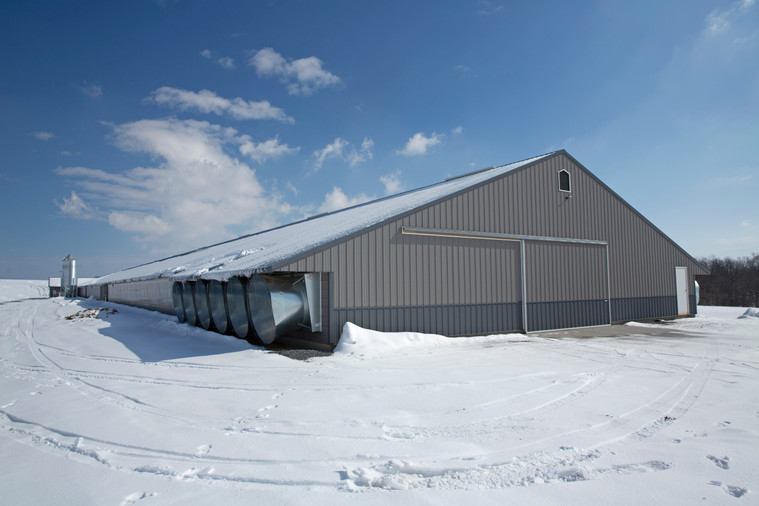
Troubleshooting Winter Ventilation Problems
Posted by and Reviewed by Farmer Boy on Dec 2, 2025
Maintaining comfortable conditions for your flock during cold weather presents a challenge. You need to conserve heat while simultaneously ensuring adequate fresh airflow to manage moisture and gases. Fortunately, modern farming equipment and solutions simplify the process of troubleshooting common ventilation issues that farmers encounter.
Fast Diagnosis Tips
Condensation on walls
Condensation often occurs when the incoming air (inlet throw) is weak, or if air bypasses the intended inlets due to building leaks.
How to fix this:
- Observe the inlet behavior when the minimum ventilation fans activate.
- Do the inlets open uniformly and direct a jet of air along the ceiling?
- Verify the static pressure; a typical goal is between 0.07 and 0.12.
- Monitor humidity and temperature in the animal zone using in-barn sensors.
Ammonia smell in the barn
If you notice a strong ammonia smell, it indicates insufficient air exchange.
How to fix this:
Confirm that air inlets direct air across the ceiling, avoiding direct drafts onto the animals.
Cold drafts near livestock area
Air leaks can cause air to bypass the planned inlet path (short-circuits) or result in cold air being sucked back in through fans (back-draft).
How to fix this:
- Inspect curtains and fan placement for gaps and damaged seals.
- Back-draft solutions such as fan chutes, fan caps, and insulated fan covers - can help prevent cold air from drafting back into the barn.
The 5-Step Winter Ventilation Guide
Use this field-ready sequence to quickly diagnose airflow problems, adjust air inlets, and stop cold drafts before they start.
- Check inlets and static pressure:
- Confirm there’s even openings and smooth linkage
- Check static pressure, if it’s too low, you’re likely leaking air.
- Add a second minimum fan:
- Adding a two smaller fans often perform better than one large fan
- Cross-check nameplate for the fan’s cubic feet per minute (CFM) against timer duty cycle.
- Tune inlet setup:
- Eliminate stale air
- Use a smoke test to identify where air is not following in problem areas.
- Add a recirculation fan and stir fans to move warm ceiling air down across the floor.
- Identify building leaks
- Leaks can short-circuit your system by letting cold air in. Check these areas:
- Between curtains: Use reflective insulation
- Ceiling holes: Weather resistant tape to seam
- Fan openings: fan caps help prevent cold-back drafts
- Leaks can short-circuit your system by letting cold air in. Check these areas:
Fine Tuning By Livestock Breed
Animal needs vary by species. Here’s how to adjust winter ventilation for swine, cattle/dairy, and poultry for steady, draft-free air.
Swine
- Maintain consistent minimum ventilation to manage moisture and ammonia without causing a chill.
- Inlets must direct air along the ceiling, preventing cold drafts from blowing directly into the pens.
- Install fan chutes, fan caps, and insulated fans to prevent backdrafts.
Cattle/Dairy
- Ensure airflow is draft-free. Calves require gentle air mixing, not cold blasts at animal height.
- Use ceiling or stir fans to prevent warm air from accumulating near the roofline.
- Wet or slow-drying bedding usually indicates insufficient air exchanges. Increase minimum ventilation or adjust inlet settings.
Poultry
- Protect litter quality. Maintain air movement to control moisture and prevent caking.
- Use stir fans and basket fan in winter to circulate warm ceiling air down to the floor.
- Seal unused fans to stop reverse airflow and cold air infiltration.
Keep Your Ventilation Optimized With Farmer Boy
Good winter ventilation is not about more air, it is about moving the right air. When inlets, static pressure, and fan staging work together, you protect animal health, keep bedding and litter drier, and stabilize performance.
Do you need help with your winter ventilation? Contact the Farmer Boy team (1.800.845.3374) today to get started.